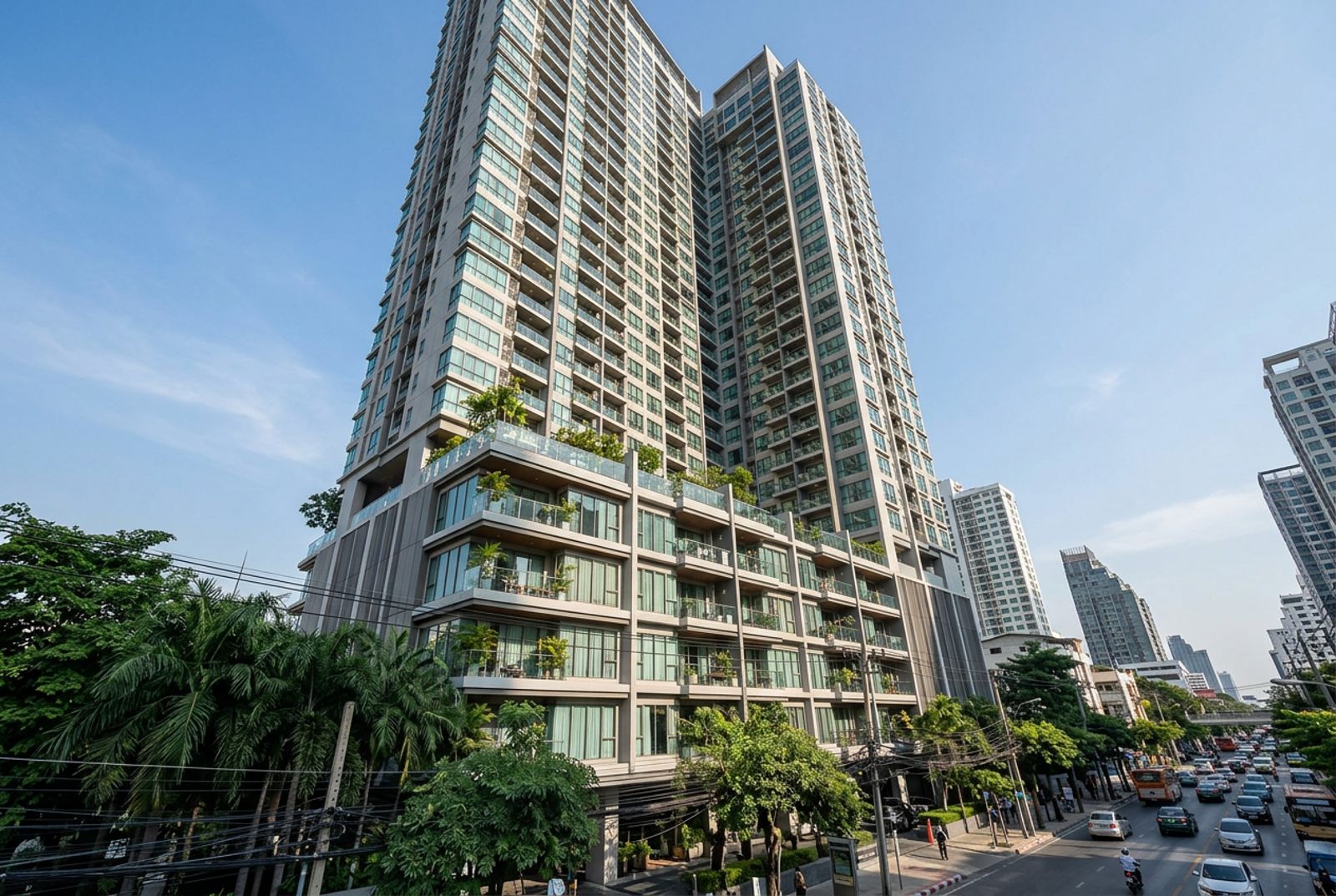
Condo Utility Bills in Thailand, How Water and Electricity Are Calculated and Why They Cost More


In Short
Advice
Key Highlights
- Most condo buildings are classified by the Metropolitan Waterworks Authority as business users rather than residential users, so water starts at 9.50 baht per cubic metre instead of the 8.50 baht residential rate
- Electricity resold to tenants has a reference ceiling of 4.88 baht per unit under the 2025 Contract Committee notification, and the Office of the Consumer Protection Board takes complaints on its 1166 hotline
- Water resold by a condo juristic person has no legal ceiling at all, and the remedy sits with the general meeting of co owners rather than with any government agency
- The national average electricity tariff for September to December 2026 is held at 3.95 baht per unit, decided by the Energy Regulatory Commission on 22 July 2026
- The new first 200 units at 3 baht measure that starts with September 2026 bills is attached to the utility meter, so anyone paying through a building sub meter does not receive it automatically
What do condo utility bills actually cover?
Foreign renters and buyers in Bangkok often compare two units with similar rent and assume the running costs will be similar too. They frequently are not. The reason has little to do with how much water or electricity you personally use, and almost everything to do with whose name is on the meter.
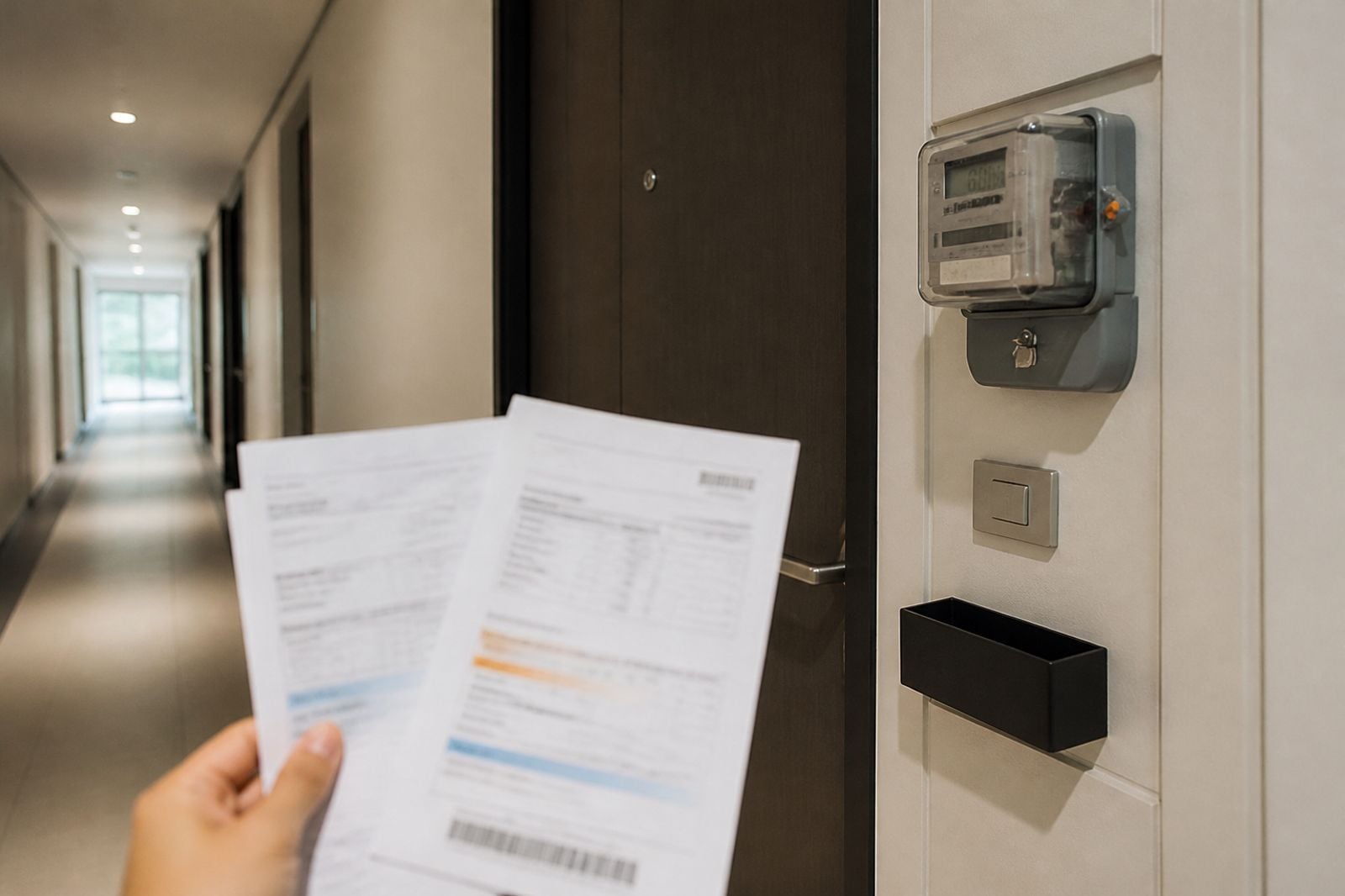
A house is a single account with the water and electricity authority, billed at published residential rates. Many condo buildings instead hold one master account, and the juristic person or the individual owner reads a sub meter outside your door and re bills you. That one extra layer changes the tariff used in the calculation, and it changes which body regulates the result.
This guide separates the two utilities on purpose, because in Thailand they sit under completely different regimes. Electricity has a published ceiling and a complaints hotline. Water has neither. Knowing that difference means you raise the issue in the right place the first time instead of being passed between agencies.
How does condo electricity differ from house electricity?
The residential tariff that applies when the meter is in your own name
The Metropolitan Electricity Authority charges households on a progressive scale, and splits that scale again depending on monthly consumption.
| Monthly consumption | Energy rate and service charge |
|---|---|
| Under 150 units a month | Units 1 to 15 are 2.3488 baht, units 16 to 25 are 2.9882 baht, units 26 to 35 are 3.2405 baht, units 36 to 100 are 3.6237 baht, and units 101 to 150 are 3.7171 baht per unit, with a monthly service charge of 8.19 baht |
| Over 150 units a month | The first 150 units are 3.2484 baht, units 151 to 400 are 4.2218 baht, and units from 401 onward are 4.4217 baht per unit, with a monthly service charge of 38.22 baht |
| Not included in the rates above | These are energy charges only and exclude the Ft adjustment and value added tax |
Once the Ft adjustment, service charge and VAT are added, a unit with its own direct meter typically pays somewhere around 3.93 to 4.26 baht per unit. The national average tariff for the September to December 2026 billing cycle is 3.95 baht per unit with an Ft of 16.23 satang per unit, set by the Energy Regulatory Commission at its meeting number 29/2026 on 22 July 2026, using 16,127.17 million baht of clawed back surplus to hold the rate steady.
The small business tariff that applies when the building buys the power
Where the master meter sits in the building name, the juristic person is the customer, not you, and the building is usually billed on the small business tariff.
| Consumption tier | Rate |
|---|---|
| First 150 units | 3.2484 baht per unit |
| Units 151 to 400 | 4.2218 baht per unit |
| Units from 401 onward | 4.4217 baht per unit |
| Monthly service charge | 46.16 baht below 12 kilovolts and 312.24 baht at 12 to 24 kilovolts |
Here is the part that matters. A whole building consumes tens of thousands of units a month, so almost every unit it buys falls into that top 4.4217 baht band. The building never benefits from the low opening bands the way a single household does, which is why the average cost it passes on is higher before any administration margin is added.
Direct meter or building sub meter, what changes?
When the juristic person buys in bulk and re bills residents
The juristic person pays one bill to the authority, then reads the sub meters outside each door to divide it up. The margin it adds usually reflects line losses between the master meter and the sum of the sub meters, meter maintenance, and the administrative cost of billing several hundred units every month.
The practical consequence is that there is no single per unit answer. Two units in different buildings that consume exactly the same amount can pay noticeably different amounts, because one building gives every unit a direct authority meter and the other does not.
The ceiling that exists, and the gap the law does not cover
The 2025 Contract Committee notification prohibits operators who rent out residential buildings from taking a profit on water and electricity, and the figure used as the all inclusive reference ceiling in 2026 is 4.88 baht per unit. If you rent and are billed above that, the direct route is the Office of the Consumer Protection Board on 1166.
That line governs the landlord and tenant relationship. It does not govern the relationship between a condo juristic person and the owners who live in their own units. An owner occupier paying utility charges to the juristic person is therefore outside that framework, and has to work through the general meeting of co owners under the Condominium Act instead. Many people only discover this after complaining to the wrong body, so it is worth establishing which of the two situations you are in before you start.
Do condo residents get the first 200 units at 3 baht?
The National Energy Policy Council resolved on 15 July 2026 to cut the first 200 units of residential electricity to no more than 3 baht per unit, by moving the cost of public street lighting out of household bills, and extended eligibility to residential rental businesses including rented houses, dormitories and apartments. It takes effect with September 2026 bills.
The detail worth reading carefully is that the entitlement attaches to the utility meter, not to the person. A unit whose meter is in the resident name receives it automatically with no registration. A unit billed through a building or owner sub meter sees the discount land in the building or owner account first, and whether it reaches you depends on whether that intermediary passes it on.
Put in money, the gap is visible. A unit consuming 200 units a month on the over 150 residential tariff pays an energy charge of 150 times 3.2484 plus 50 times 4.2218, which is 698.35 baht, against 600 baht at the 3 baht ceiling. That is 98.35 baht a month, or roughly 1,180 baht a year, calculated on the energy charge alone before Ft, service charge and VAT.
The useful action is simple. Ask your juristic person or landlord in writing whether the rate charged from the September 2026 bill onward has been adjusted to reflect the measure, and ask them to show the calculation. This is the first time the difference between a direct meter and an intermediary meter has translated into a figure you can point at.
Condo and house rates compared, item by item
Every item below reports the same set of points in the same order, so you can read across them without interpreting anything.
Water, the residential tariff from the Metropolitan Waterworks Authority
| Item | Detail |
|---|---|
| Who pays this | Houses, townhouses, and condo units whose water meter is in the resident name |
| Opening rate | 8.50 baht per cubic metre for the first 0 to 30 cubic metres |
| Top rate | 14.45 baht per cubic metre above 200 cubic metres |
| Monthly service charge | 25 baht for a half inch meter, rising with meter size to 5,000 baht for a 16 inch meter |
| Regulator | The Metropolitan Waterworks Authority, and rates exclude value added tax |
Water, the business tariff that covers condo buildings
| Item | Detail |
|---|---|
| Who pays this | Condo buildings billed through a master water meter, grouped with business, government, state enterprise and industrial users |
| Opening rate | 9.50 baht per cubic metre with a minimum charge of 90 baht |
| Top rate | 15.81 baht per cubic metre |
| Monthly service charge | Also set by meter size, and buildings use large meters so they pay far more than a house does |
| Regulator | The Metropolitan Waterworks Authority, and rates exclude value added tax |
Water, the rate the juristic person actually charges residents
| Item | Detail |
|---|---|
| Who pays this | Residents in buildings where the juristic person reads sub meters and issues its own bills |
| Rates reported in Bangkok | Roughly 10 to 25 baht per unit |
| Rates reported in some provinces | Roughly 30 to 40 baht per unit where raw water costs more |
| What the margin covers | Electricity for the pumps that lift water to rooftop tanks, pipe and meter maintenance, water used in common areas, and wastewater treatment |
| Regulator | None, the Land Department, the Office of the Consumer Protection Board and the Bangkok Metropolitan Administration have each said the matter falls outside their authority |
Electricity, what you pay with a direct meter
| Item | Detail |
|---|---|
| Who pays this | Condo units with an authority meter registered in the resident name |
| All inclusive rate paid in practice | Roughly 3.93 to 4.26 baht per unit |
| National average tariff for September to December 2026 | 3.95 baht per unit |
| First 200 units at 3 baht entitlement | Received automatically with no registration |
| Regulator | The Energy Regulatory Commission and the Metropolitan Electricity Authority |
Electricity, what you pay through an intermediary
| Item | Detail |
|---|---|
| Who pays this | Condo units billed by a juristic person or an individual owner reading a sub meter |
| Reference ceiling | 4.88 baht per unit all inclusive where the counterparty is a residential rental business |
| Legal basis | The 2025 Contract Committee notification, which prohibits taking a profit on water and electricity |
| First 200 units at 3 baht entitlement | Not automatic, it depends on the intermediary passing it on |
| Regulator | The Office of the Consumer Protection Board on 1166 for tenants, and the general meeting of co owners for owner occupiers |
Read those five items together and one conclusion falls out. Electricity has a line to hold and a body that will take your call. Water has neither. So the question to settle before you sign a lease or complete a purchase is not only what the rate per unit is, but whose name the meters are in.
How much do utilities cost per month by unit size?
Published figures that can be verified cover one bedroom units in Bangkok. Studios and two bedroom units do not yet have a comparable published dataset, so this section gives the sourced figure plus the method to work out your own rather than inventing numbers for the other sizes.
One bedroom units, the size with published data
| Item | Detail |
|---|---|
| Electricity per month | Roughly 2,000 to 4,000 baht |
| Water per month | Roughly 150 to 350 baht |
| Total utilities per month | Roughly 2,500 to 5,000 baht |
| Share coming from electricity | Roughly 70 to 80 percent of the total |
| Source and date | Superagent published 13 August 2024, so treat it as a frame rather than a current exact figure |
Working out air conditioning cost, which is the largest single item
The formula is BTU divided by the SEER rating, divided by 1,000, multiplied by hours run per day, multiplied by days, multiplied by the rate per unit.
Take a 12,000 BTU unit with a SEER of 20, run 8 hours a day for 30 days at 3.95 baht per unit. That is 12,000 divided by 20 divided by 1,000, which is 0.6 kilowatts, times 8 hours, times 30 days, which is 144 units, times 3.95 baht, or 568.80 baht a month.
Billed instead at the 4.88 baht ceiling, the identical usage costs 702.72 baht a month. The difference is 133.92 baht a month, or roughly 1,607 baht a year, for behaviour that has not changed at all.
Working out your water cost
Read the meter outside your door twice, 30 days apart, and multiply the difference in cubic metres by the rate printed on your bill. If the result does not match the billed amount, the gap is service or common area cost that has been folded in, and you are entitled to ask what it is made of.
What two extra points apply only to foreign renters and buyers?
First, foreign tenants are the group most often billed above the ceiling, because serviced apartments and furnished units marketed to expatriates are where the highest per unit rates cluster. Guides written for this audience have reported building rates of 6 to 9 baht per unit, which sits well above the 4.88 baht reference ceiling. If your lease is with a residential rental business, that is a conversation worth having before you sign rather than after, and you have room to negotiate the rate into the contract as a written figure per unit.
Second, the September 2026 first 200 units measure covers residential rental businesses, which means the discount reaches the building account for many expatriate rentals even when the tenant is not Thai. Nothing in the measure limits it by nationality of the occupant. So a foreign tenant paying through a landlord meter has exactly the same standing to ask whether the reduction has been passed through as a Thai tenant does.
How do you check whether you are being overcharged?
Work through these five steps in order. They take under an hour in total and give you something concrete to put in front of your building manager.
- Step 1, check whether the bill shows units consumed, rate per unit and service charge separately. A bill that shows only a total is the first sign that you should request a breakdown
- Step 2, divide the total electricity charge by the units consumed. If the result is above 4.88 baht per unit and you are a tenant, ask for a written explanation
- Step 3, ask whether your unit has an authority meter or a building sub meter. That single answer decides which framework you sit under
- Step 4, ask whether the first 200 units at 3 baht measure that began with September 2026 bills has reached your unit, and if not, why not
- Step 5, if you are a tenant and get no answer, contact the Office of the Consumer Protection Board on 1166. If you are an owner, table it as an agenda item at the general meeting of co owners, because no agency sets a ceiling on water for you
Collect at least six months of bills before you open the conversation. A run of figures over time carries far more weight than a single month held up as a complaint.
Six ways to reduce condo electricity costs that actually work
These are ordered by impact, and limited to what you can do inside a unit without altering anything that counts as common property.
- Set the air conditioner to 26 degrees Celsius and use a fan to move the air. Cooling is the largest line on the bill, so moving the set point pays back faster than saving anywhere else
- Clean the air conditioner filters monthly and have a deep clean twice a year. A blocked filter makes the compressor run longer to reach the same temperature
- Close curtains or fit heat rejecting film on the afternoon facing side, since west facing rooms take the most heat in Thailand. Check the building rules first, as some buildings specify film type and tint to keep the facade consistent
- Unplug appliances with screens or remote controls when they are not in use, because this group draws power continuously in standby
- Switch all lighting to LED and match the wattage to the actual room size. A 30 square metre unit does not need the lighting load of a whole house
- Choose a high SEER unit when it is time to replace the air conditioner. Inverter systems use roughly 30 to 50 percent less power, and the saving grows with daily running hours
What you should not expect is to reduce the water bill through personal habits, because the share attributable to common areas is already averaged across the building. Reducing water meaningfully means reducing the per unit rate for the whole building, which goes through the general meeting of co owners.
Frequently asked questions about condo utility bills
How are condo water and electricity bills calculated, and are they higher than a house
Higher in most cases. Water is higher because a condo building on a master meter is grouped with business users starting at 9.50 baht per cubic metre rather than the 8.50 baht residential rate, and once the juristic person adds its handling cost the rate billed to residents in Bangkok lands around 10 to 25 baht per unit. Electricity is higher when an intermediary bills you, since a direct meter costs roughly 3.93 to 4.26 baht per unit while the ceiling for reselling is 4.88 baht per unit.
At what rate per unit is condo electricity considered excessive
If you rent and your counterparty is a residential rental business, anything above 4.88 baht per unit all inclusive is above the reference line set by the 2025 Contract Committee notification. The quickest test is to divide your total electricity charge for the month by the number of units consumed.
My juristic person charges a very high water rate, where do I complain
For water there is no ceiling set by any agency. The Land Department, the Office of the Consumer Protection Board and the Bangkok Metropolitan Administration have each said it falls outside their authority. The route that works is to request the cost breakdown from the juristic person and table a motion at the general meeting of co owners asking for the rate to be reviewed. If you are a tenant being overcharged by an individual owner, call 1166.
How much does a direct meter save over a year compared with a sub meter
Using the 12,000 BTU example running 8 hours a day, which consumes 144 units a month, the cost is 568.80 baht a month at 3.95 baht per unit and 702.72 baht a month at the 4.88 baht ceiling. That is 133.92 baht a month, or roughly 1,607 baht a year, for air conditioning alone. Adding other appliances and the water bill widens the annual gap further.
Are utilities included in the common area fee
No. The common area fee is charged per square metre of your unit per month, with market rates reported in a range of roughly 23 to 75 baht per square metre per month, and a separate source reporting a range of 40 to 85 baht per square metre per month. The two ranges differ because each source draws on a different set of projects. The fee covers electricity for common areas, lifts and water pumps, but not the water and power consumed inside your unit, which are metered separately.
Can I move the electricity meter into my own name
It depends on how the building electrical system was designed. Buildings that already provide an authority meter per unit make this straightforward. Buildings designed around a master meter usually cannot change it for a single unit, because the distribution system is common property. Ask the juristic person before you buy or sign, not after you move in.
Summary
Condo utility bills run higher than house bills not because condo residents consume more, but because there is an intermediary between the resident and the authority. That layer changes the tariff used, changes who regulates the outcome, and from the September 2026 billing cycle onward it also decides whether the first 200 units discount reaches you at all.
The one question worth settling before you sign a lease or complete a purchase is whose name the water meter and the electricity meter are in, and what rate per unit is actually billed. Those two answers predict your true monthly outgoings more accurately than the rent or the asking price on its own.
Bangkok's rental condo supply is dominated by one bedroom units, with two bedroom stock making up a much smaller share and starting at a noticeably higher entry point. Check the current mix on PropertyScout before you set a budget, because what is available on the platform shifts continuously.
Browse verified listings on PropertyScout
Prices and availability are subject to change and are not guaranteed. Property information is general guidance only. This content is not legal, tax, or financial advice. Water and electricity tariffs and government measures cited here are current as at August 2026 and can change. Confirm them with the Metropolitan Waterworks Authority, the Metropolitan Electricity Authority and your own juristic person before relying on them.
FAQs
Lorem ipsum dolor sit amet, consectetur adipiscing elit. Suspendisse varius enim in eros elementum tristique.

Explore More Topics
Free real estate resources and tips on how to capitalise