Condo next to the train vs 1 kilometer away, which is more worthwhile


In Short
Advice
Key Highlights
- The comparison that matters is monthly total cost, not the unit price. It has three parts, the higher instalment, the first mile transport you avoid, and the value of the extra walking time.
- The ministerial fare schedule for public motorcycle taxis caps the first 2 kilometers at 25 baht per trip, so a daily round trip works out at roughly 660 to 1,100 baht a month.
- One kilometer on a map usually becomes a 1.2 to 1.4 kilometer walk on the ground, around 16 to 19 minutes each way rather than the 12 to 14 minutes a straight line suggests.
- At 3.0 percent a year over 30 years, every extra 1,000 baht borrowed adds about 4.22 baht to the monthly instalment, which converts any price gap into a monthly figure in one step.
- Two checks apply only to foreign buyers, the 49 percent freehold quota in buildings right beside prime stations, and the fact that the 20 baht flat fare is tied to a Thai national ID.
When does paying more to live beside the station pay off?
The short answer is that paying more to live beside the station pays off while the extra instalment stays below what you would otherwise spend, in cash and in time, living a kilometer away. Once the gap grows past that line, moving out and putting the difference into floor area or savings does more for you.
The mistake people make here is comparing the price per square meter of two units and calling the lower priced one better value. That comparison ignores three costs that appear every month after you move in, and those three costs are what actually settle the question.
Condo next to the train vs 1 kilometer away is therefore not a question with one answer for everyone. Someone in the office five days a week and someone working mainly from home will reach opposite conclusions while looking at the very same pair of units.
The three costs to compare, not just the unit price
Three costs genuinely differ between the two options. One goes to the bank, one goes to a driver or a fuel pump, and one is not paid in money at all but in time. All three have to be converted into baht per month before any comparison makes sense.
How much does the unit price change the monthly instalment
Convert the price gap into a monthly instalment using the market average rate for the first three years. The July 2569 table compiled by AP Thai puts that range at 2.55 to 3.55 percent a year. Every example in this guide uses the midpoint of 3.0 percent a year over a 30 year term.
On those terms, every extra 1,000 baht borrowed adds roughly 4.22 baht to the monthly instalment. A unit that costs 600,000 baht more therefore adds around 2,530 baht a month. That multiplier of 4.22 works in any location, you only swap in the price gap for the units you are actually looking at.
If your approved rate differs from 3.0 percent the multiplier moves with it, to about 3.98 baht at 2.55 percent and about 4.52 baht at 3.55 percent per 1,000 baht borrowed. Foreign borrowers usually see rates well above that Thai retail range, so use the figure on your own offer letter rather than an advertised one.
What does the first mile to the station cost each month
Public motorcycle taxi fares are capped by ministerial regulation. The first 2 kilometers may not exceed 25 baht, the 2 to 5 kilometer band adds no more than 5 baht per kilometer, the 5 to 15 kilometer band adds no more than 10 baht per kilometer, and anything beyond 15 kilometers is negotiable up to 150 baht per trip. Charging above the schedule carries a fine of up to 5,000 baht. Thai PBS and Matichon report the same structure.
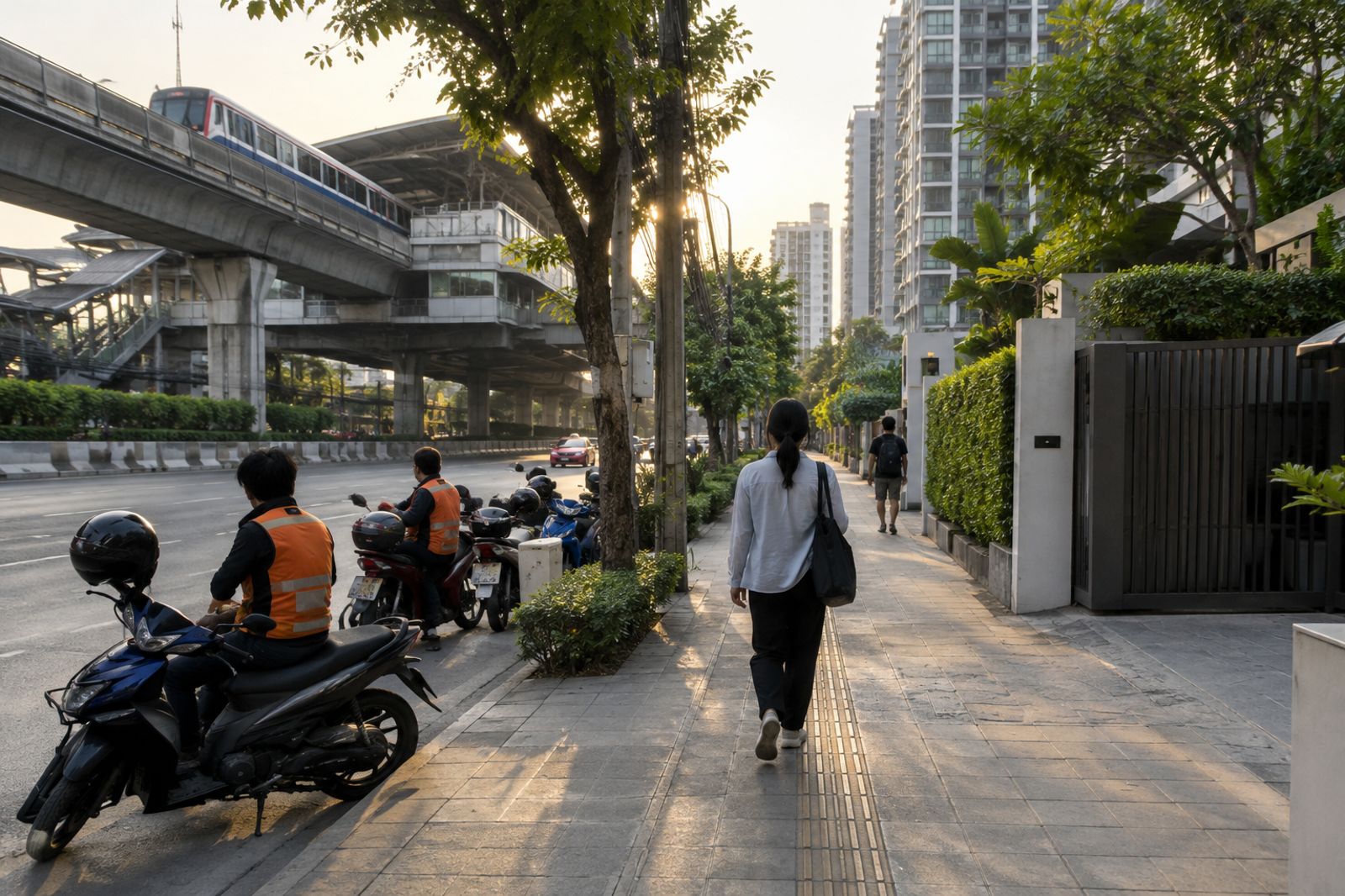
A one kilometer hop sits entirely inside that first band, so 25 baht is the ceiling per trip. In practice many ranks charge less on short hops, commonly around 15 baht. Riding both ways on 22 working days a month therefore lands between roughly 660 baht at 15 baht a trip and roughly 1,100 baht at the 25 baht ceiling.
Two things are worth knowing if you are new to Bangkok. Knowing the legal ceiling is the simplest protection against being quoted a foreigner price at the rank, and ride hailing apps show a fare before you get on, which many newcomers find easier than negotiating. If you drive instead, replace this line with fuel, tolls, and monthly parking, which usually costs several times more.
What is the extra walking time worth per month
Transit oriented planning work uses a walking speed of about 1.2 to 1.4 meters per second, or roughly 72 to 84 meters a minute. A straight kilometer is therefore a 12 to 14 minute walk. Real street networks add a detour factor of about 1.2 to 1.4 times, so the walk becomes 1.2 to 1.4 kilometers and takes around 16 to 19 minutes each way.
The examples below use a midpoint of 13 minutes each way, about 26 minutes a day for the round trip. To price that time, divide your monthly income by 22 working days and then by 8 hours. Someone earning 30,000 baht a month values an hour at about 170 baht. For reference, the Bangkok minimum wage of 400 baht a day, set by Wage Committee Announcement No. 14 and in force since 1 July 2568, works out at about 50 baht an hour.
Be clear that this figure is not cash leaving your account, so never add it to the instalment on a loan application. Use it as weight in the decision instead. Bangkok heat and humidity also make a 19 minute walk feel longer than the same walk in a temperate city, which is a factor newcomers routinely underestimate in their first year.
Why is the train fare not part of this comparison?
Plenty of guides still argue that living close to a station saves on fares, which was true when fares were charged by distance travelled. The 20 baht flat fare policy now covers eight lines, the Blue, Purple, Red, Pink, Yellow, Green and Gold lines plus the Airport Rail Link. Registration through the Thang Rat app opened on 25 August 2568 and the fare took effect on 1 October 2568, with no closing date for registration according to Thai PBS.
The consequence matters more than it first appears. Someone living beside the station and someone living a kilometer away board at the same station and pay exactly the same fare. The only variable left is the first mile. Comparing train fares between the two options tells you nothing, comparing the ride or walk from your door to the platform tells you everything.
For foreign residents there is a catch. The flat fare is tied to registration with a 13 digit Thai national ID, so most foreigners pay standard fares. That raises your monthly transport budget in both scenarios equally, which means it changes your budget without changing the answer to this particular question.
Monthly total cost across 3 scenarios and the break even price gap
All three scenarios use the same assumptions. A motorbike fare of 15 to 25 baht a trip, 26 minutes of extra walking a day, time valued at 170 baht an hour, interest at 3.0 percent a year, and a 30 year term. Every figure below is calculated from those assumptions rather than measured across the market, so changing an assumption changes the result.
Commuting every workday, 22 days a month
| Item | Approximate figure |
|---|---|
| Extra transport paid in cash | Roughly 660 to 1,100 baht a month |
| Value of the extra walking time | Roughly 1,625 baht a month |
| Total cost of living farther out | Roughly 2,285 to 2,725 baht a month |
| Price gap that breaks even | Roughly 540,000 to 650,000 baht |
| As a share of a 3,000,000 baht unit | Roughly 18 to 21 percent |
This group gains the most from being beside the station. If the station side unit costs less than about 18 percent more, paying up for it holds together under this set of assumptions.
In the office 2 to 3 days a week, about 10 days a month
| Item | Approximate figure |
|---|---|
| Extra transport paid in cash | Roughly 300 to 500 baht a month |
| Value of the extra walking time | Roughly 739 baht a month |
| Total cost of living farther out | Roughly 1,039 to 1,239 baht a month |
| Price gap that breaks even | Roughly 250,000 to 290,000 baht |
| As a share of a 3,000,000 baht unit | Roughly 8 to 10 percent |
This is the group where the numbers swing hardest, because the price gap you can justify falls by almost half compared with a five day commute. It is also the pattern most common among professionals posted to Bangkok on hybrid contracts.
Working mainly from home, out about 4 days a month
| Item | Approximate figure |
|---|---|
| Extra transport paid in cash | Roughly 120 to 200 baht a month |
| Value of the extra walking time | Roughly 295 baht a month |
| Total cost of living farther out | Roughly 415 to 495 baht a month |
| Price gap that breaks even | Roughly 100,000 to 120,000 baht |
| As a share of a 3,000,000 baht unit | Roughly 3 to 4 percent |
For this group the premium the market charges for a station side unit is usually well above the figure the calculation supports. Moving out and spending the difference on floor area or a higher floor tends to serve you better, unless resale and rental demand weigh more heavily than daily living.
How do you measure the real price gap in your location?
There is no central Thai dataset that measures the price gap by actual walking distance and can be traced back to source. The figures circulating in the market are usually drawn from a straight line radius or from whichever station name is closest, which is a different definition. Rather than quote a percentage we cannot stand behind, here is a method you can run in an hour.
- Pick one target station and define two bands, an inner band within a 300 meter walk and an outer band at about a 1 kilometer walk, measured along real walking routes on the map rather than as a circle
- Collect at least 5 listings of similar size in each band, keeping bedroom count and building age close, because those two variables distort price more than distance does
- Divide each asking price by usable area to get a price per square meter for every listing
- Take the median of each band and express the gap as a percentage, using the median rather than the mean so that one overpriced listing does not skew the whole set
- Take the baht gap for the units you are actually considering, multiply by 4.22 and divide by 1,000 to get the monthly instalment difference, then compare it against the scenario that matches your life
The step people skip is the first one. Measuring along real walking routes instead of a radius moves a surprising number of listings from the inner band to the outer one, because the path has to go around a canal, an expressway pier, or a major junction with a long signal. If you are choosing from photos before you have stood on that corner, this step is the one that protects you.
How do resale and rental demand differ between the two?
The supply side gives a clearer signal than asking prices do. The gap shows up at station level, not at district level. The whole of Sukhumvit starts at the same figure as the whole of Bangkok, but narrow it to a single station and the entry point rises by about 25 percent. Being in a good district is not the same thing as being within walking distance of a platform.
On returns, the PropertyScout rental yield guide notes the 6 to 8 percent a year that investors often aim for, while 2569 data from myproperty.in.th puts the Bangkok condo average at roughly 4 to 6 percent a year. Both are historical reference ranges rather than a promise that any given unit will perform at those levels. Station side units usually let faster because tenants without cars depend on the network, though the higher purchase price also pushes down the yield, so the sum has to be done unit by unit.
Which two extra checks apply only to foreign buyers?
The first is the 49 percent freehold quota. Foreign buyers may hold freehold title to no more than 49 percent of the total unit area in a building, and older buildings beside prime stations are exactly where that quota tends to be used up. If the station side unit is only available on a leasehold structure while the unit a kilometer out is freehold, you are no longer comparing like with like, and the difference in rights and in resale market usually outweighs a 15 minute walk. Ask the juristic person how much quota remains and get the answer in writing before you place a deposit.
The second is transfer costs. The reduced registration fees of 0.01 percent are limited to Thai national buyers, so foreign buyers budget at standard rates on both options. That does not change which side wins, but it does change the cash you need at transfer, and it scales with price, so the more expensive station side unit costs more here too.
When does living farther out become the better buy?
Three conditions decide it. The first is commute frequency. Below three office days a week, the price gap you can justify drops to around a third of what a five day commuter can carry, which is usually less than the market charges.
The second is the quality of that kilometer. A shaded route with continuous footpaths and no major crossing means you will actually walk it on ordinary days and the motorbike cost stays optional. A route along an exposed main road with broken footpaths turns that fare into a fixed daily expense instead.
The third is what the saving buys you. If 600,000 baht buys another 10 to 15 square meters or a second bedroom, someone working from home benefits from that space every day. If the same amount only buys two extra floors of height, moving out has not given enough back.
Who should choose the station and who should move farther out?
- Choose the station side if you commute by train five days a week, regularly come home late, do not own a car and do not plan to, are buying to let to tenants who rely on the network, or find long walks difficult
- Choose farther out if you work mainly from home, need an extra bedroom within the same budget, have a car and secure parking, value quiet and green space over travel time, or want to keep the instalment low to protect your cash flow
- Run the numbers unit by unit if you are buying as an investment without a fixed plan to let or resell, because returns depend far more on the price you actually pay than on the distance to the platform
If you cannot decide, the lowest risk route is to treat a first year lease as a test of the walk rather than a test of the unit. Walking the same route once in the rain and once on the way home after dark will tell you more than any calculation on paper.
Frequently asked questions about a condo next to the train vs 1 kilometer away
Should you buy a condo next to the train or farther out
It depends on how often you travel. Convert the price gap into a monthly instalment using roughly 4.22 baht per 1,000 baht borrowed at 3.0 percent over 30 years, then compare it with the total cost of living farther out. A five day commuter can justify roughly 540,000 to 650,000 baht, someone in the office 2 to 3 days a week roughly 250,000 to 290,000 baht, and someone working mainly from home roughly 100,000 to 120,000 baht. If the real gap is larger than that, moving out is the better buy.
Is a 1 kilometer walk to the station manageable and how long does it take
At a walking speed of about 72 to 84 meters a minute, a straight kilometer takes 12 to 14 minutes. Real routes run about 1.2 to 1.4 times longer than the straight line, so expect 16 to 19 minutes each way, before any wait at crossings. Walk the route yourself once at the hour you would actually use it, and once in the rain, before you decide.
How much should a motorbike taxi cost for 1 kilometer from the station
One kilometer falls inside the first 2 kilometer band, which the ministerial schedule caps at 25 baht per trip. Short hops are commonly charged at around 15 baht in practice. Quoting the ceiling politely is usually enough if you are asked for more, and charging above the schedule carries a fine of up to 5,000 baht. Ride hailing apps are a simple alternative if you would rather see the fare before you get on.
Does living farther from a station make a unit harder to resell
Rentals near BTS Asok sit at roughly 25 percent above the entry point for Bangkok as a whole, so the market does pay for walking distance. That does not mean units farther out fail to sell. The price you paid at the start, the condition of the building, and how well the juristic person runs it carry similar weight. Prices and availability change constantly and nothing here is guaranteed.
Does the 20 baht flat fare make living beside a station less necessary
It removes the fare saving argument entirely, because both residents board at the same station and pay the same fare. What still differs is time and the first mile. Foreign residents who cannot register for the flat fare pay standard fares, which raises the transport budget on both options equally and leaves the comparison unchanged.
Summary
Whether a condo next to the train or one a kilometer away is the better buy comes down to three lines of arithmetic. Convert the price gap into a monthly instalment, add the first mile transport you would avoid, and put a value on the extra walking time. Once all three sit in the same unit, the answer becomes clear, and it lands differently depending on how often you actually travel.
The practical next step is to pick one target station and compare similar units across the two walking bands using the method above. A PropertyScout consultant can pull the comparison set for both bands, check the ownership quota and building rules on each project, and walk you through what the numbers mean. Browse verified listings to start comparing, and work with an agent who speaks your language.
Please note. Prices and availability change and nothing here is guaranteed. Property details and figures in this guide are general information only, all calculations are worked examples based on the assumptions stated in the text rather than market averages, and this content is not legal, tax, or financial advice.
FAQs
Lorem ipsum dolor sit amet, consectetur adipiscing elit. Suspendisse varius enim in eros elementum tristique.

Explore More Topics
Free real estate resources and tips on how to capitalise